


Space Research
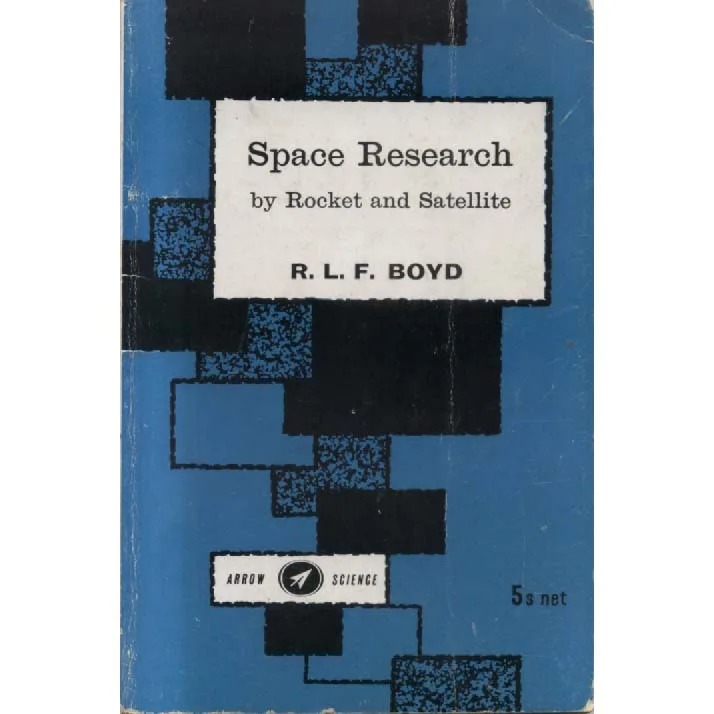
Publisher: Arrow Books
Format: Paperback
ISBN: none
Space Research (1960)
By R. L. F. Boyd | Arrow Books
ISBN: none (launched pre-barcode era)
Condition: Good (orbit-stable, mildly retro-futuristic)
Offered by: Crappy Old Books
This is Space Research (1960), from that magnificent moment in history when “space” meant:
-
Rockets that looked like rockets
-
Computers the size of wardrobes
-
And a collective belief that by about 1990 we’d all have moon timeshares and tasteful silver jumpsuits.
R. L. F. Boyd sits you down, straightens his tie and calmly explains what humanity is actually doing up there, using the best mid-century science and the finest diagrams a slide-rule can buy.
What’s inside (besides optimism and equations)
Expect a guided tour through:
-
Rockets and propulsion – why things have to go very, very fast to escape Earth, and how not to explode in a completely undignified way on the launchpad.
-
Satellites – freshly minted marvels at the time, not yet reduced to “things that tell you where the nearest coffee shop is.”
-
Space environment – vacuum, radiation, temperature extremes; all the reasons space would kill you instantly if given half a chance.
-
Scientific experiments in orbit and beyond – cosmic rays, solar wind, atmospheric studies, and other concepts you can borrow to sound clever at parties.
It’s written before the Moon landing, so the whole thing hums with anticipation: space is not routine, it’s still a terrifying, thrilling frontier.
The tone: serious science, pre-meme
Boyd writes as a proper scientist of 1960:
-
Clear, precise, and encouragingly unflustered by the whole “leaving the planet” business.
-
Explanations are straightforward, with just enough maths to look respectable but not enough to make your eyes water.
-
The overall vibe is:
“Yes, this is very difficult, but we are British and we shall proceed calmly.”
It’s the polar opposite of modern hypevertising. No “disruption”, no “space tourism”, just earnest talk about ionisation, telemetry and trajectories.
This particular copy
-
Condition: Good – which in Crappy Old Books-speak means:
-
Solid binding, still happily holding its component chapters in a stable orbit.
-
The cover has some honest wear: edge rubbing, maybe a crease or two, the paperback equivalent of scorch marks from re-entry.
-
Pages are all present and readable, likely a little tanned with age, like a veteran mission controller.
-
No missing chapters, no mysterious burns, no evidence of having been used to steady a wobbly lab bench.
The vibe
Reading Space Research feels like:
-
Sitting in a small lecture theatre while a distinguished physicist explains why satellites don’t just fall down.
-
Time-travelling to the moment when “space” was not yet wallpaper but headline news and genuine wonder.
-
Realising how much of what we now take for granted—GPS, communications, weather forecasting—was still speculative and faintly miraculous.
It’s a snapshot of how we thought about space before it was crowded with TV satellites, spy platforms and billionaire midlife crises.
Why you might actually want this
-
You’re into history of science and want to see how the early space age explained itself to curious laypeople.
-
You enjoy Cold War-era science writing: sober, confident, just a little bit thrilled.
-
You like comparing what people imagined in 1960 with what actually happened:
-
some of it surprisingly accurate
-
some of it adorably optimistic
-
-
You’re the sort of person who likes a small retro paperback about space sitting on your desk like a quiet nerd-flex.
It’s also handy if you want to sound impossibly sophisticated by saying things like, “Of course, early space research focussed primarily on ionospheric studies…”
Condition vs. Cosmos
-
Physically: Good – perfectly adequate for armchair reading, commuting, or stashing in a satchel next to a slide rule you absolutely don’t need.
-
Intellectually: vintage but solid – the fundamentals of orbits, rockets and experiments haven’t changed, even if the hardware now fits in smaller boxes.
No glossy colour photos, no inspirational quotes in large type—just compact, 1960s competence about rockets and the void.
Ideal for:
-
Space nerds with a love of retro
-
Collectors of old popular-science paperbacks
-
Anyone bored of modern science communication being all vibes and no diagrams
-
People who find it pleasing that a book about early Space Research has itself survived re-entry into second-hand life via Crappy Old Books
Offered by Crappy Old Books, where the rockets are schematic, the tone is earnest, the condition is Good, and the future still has that reassuring 1960s smell of ozone and optimism.
Keep browsing: See more Space books Other books by RLF Boyd
